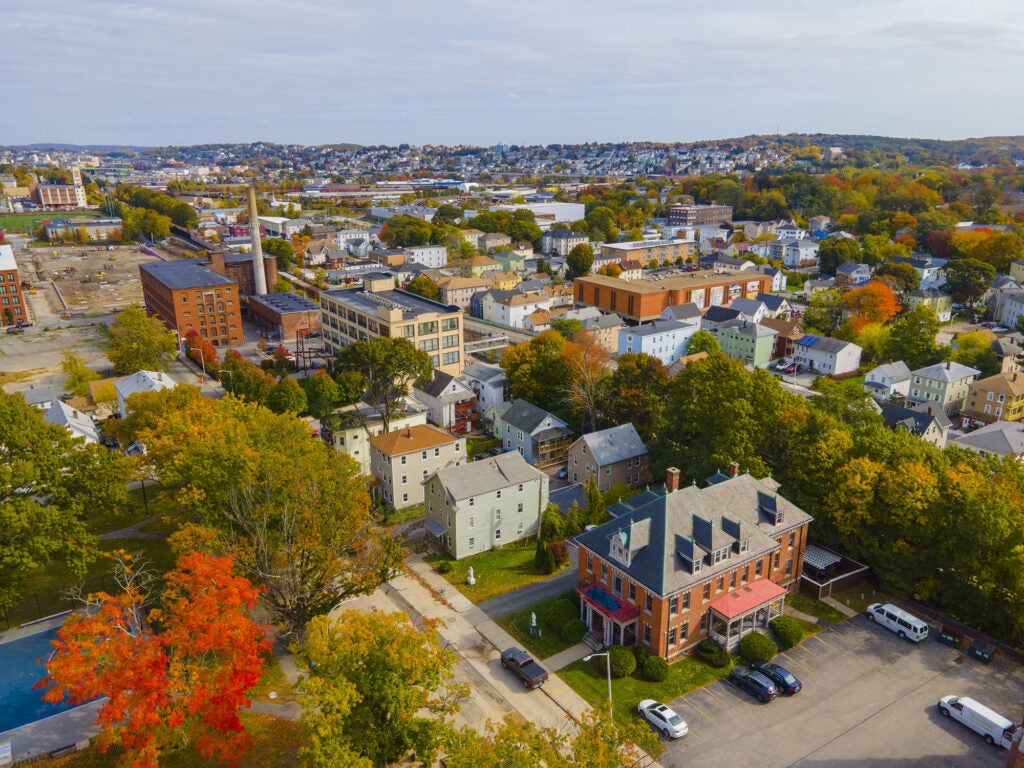
Salem’s Heaven and Earth Geothermal Loop Advances to Predevelopment Phase
New funding and technical support from state and philanthropic sources will move Salem’s proposed downtown geothermal energy network into predevelopment planning work, tackling the financial and engineering tasks needed to bring clean, sustainable energy to downtown Salem residents, businesses and institutions.
November 17, 2026
SALEM, Mass. – November 17, 2026 – Salem Mayor Dominick Pangallo, the Massachusetts Community Climate Bank at MassHousing, the Massachusetts Department of Energy Resources (DOER), the Massachusetts Clean Energy Center (CEC), MassDevelopment and the Essex County Community Foundation jointly announced today that Salem’s proposed Heaven and Earth Energy Project is advancing to the predevelopment phase, thanks to significant new funding and direct support from state and philanthropic sources.
The Heaven and Earth Energy Project is a proposed geothermal energy network and resilience hub centered on downtown Salem. The project aims to reduce greenhouse gas emissions, lower energy costs, improve reliability, and strengthen community resilience through integrated clean energy solutions. Geothermal heating is a clean energy source that is more efficient than fossil fuel heating and has been shown to reduce emissions, energy usage, and long-term operating costs to end users. The Heaven and Earth geothermal energy network loop would serve businesses, homes and institutions in downtown Salem.
Salem previously partnered with MassCEC and the clean energy nonprofit HEET to confirm the technical feasibility of the proposed geothermal energy loop. Today’s announcement moves the project from the feasibility stage to predevelopment.
Predevelopment work will advance the proposed geothermal project by completing decarbonization and building retrofit analyses for buildings that could be heated and cooled by the geothermal project, as well as advancing necessary technical, financial and governance work on the proposed loop.
“The Heaven and Earth Energy Project will help us meet our climate goals while also addressing affordability and lowering energy costs,” said Salem Mayor Dominick Pangallo. “This innovative community-lead initiative will accelerate the progress we’ve already made here in Salem in both of those areas and also serve as a model for other communities throughout the Commonwealth and beyond. This work would not be possible without vital support from our state partners, organizations like the Essex County Community Foundation and St. Peter’s/San Pedro’s, and National Grid. We’re grateful for their support and commitment to this shared vision and are excited for the next phase of Heaven and Earth!”
“The Massachusetts Community Climate Bank at MassHousing is proud to partner with the City of Salem and St. Peter’s – San Pedro Church, to help bring their exciting vision of a downtown geothermal energy network closer to fruition,” said Maggie Super Church, Director of Policies and Programs for the Massachusetts Community Climate Bank at MassHousing. “The MCCB funds clean energy projects that are replicable and scalable across Massachusetts. Salem’s Heaven and Earth energy project would connect residents and businesses to renewable, carbon-free heating and cooling in a way that centers the needs of the community.”
“Through our climate resiliency initiative, we back collaborative, innovative solutions designed to meet community need while preparing for a healthy and sustainable future,” said Stratton Lloyd, President and CEO of Essex County Community Foundation. “We’re thrilled to partner with Mayor Pangallo and the Massachusetts Community Climate Bank at MassHousing by offering catalytic funding that supports Salem’s vision for a geothermal energy network, the potential for long-term cost savings and a clean energy model ready to replicate across Essex County.”
“This project demonstrates how public-private partnerships can make big things happen,” said Energy Resources Commissioner Elizabeth Mahony. “DOER is proud to provide technical assistance for three Salem Housing Authority buildings that will allow them to evaluate their participation in this geothermal loop. We are thrilled to support projects like these which help deploy clean, efficient heating and cooling systems that reduce energy costs and emissions.”
“Salem’s feasibility study showed that a geothermal network could work downtown. This next phase will help determine what it will take to make it a reality,” said Jim Stanislaski, MassCEC Managing Director of Accelerating Decarbonization. “Salem has a diverse mix of buildings, each with different heating systems, levels of insulation, and other factors that affect its readiness to connect to a geothermal loop. These building assessments will give owners a clearer picture of the upgrades needed to prepare their properties for connection, so the loop can be designed around real demand.”
“As a church, we feel called to take impactful action against climate change now,” said Rev. Nathan Ives of St. Peter’s – San Pedro Church in Salem. “Not just because it affects our bottom line, but because it’s good for our neighbors’ health and our grandchildren’s future, and because in doing so we respect God’s creation. The Heaven and Earth Energy Project at St. Peter’s – San Pedro is being planned by, for, and with the community so we can chart a new fossil fuel free course to heat and cool our homes and businesses in downtown Salem. Join us!”
Geothermal is a clean energy source that uses the earth’s underground temperature to heat and cool buildings. Geothermal networks use drilled boreholes, distribution pipes and heat exchange systems to transfer heat between the earth and buildings. Geothermal heat pumps are extremely efficient, heating buildings as much as five-times more efficiently than gas- and oil-fired furnace systems. Because they do not burn fuel, geothermal heating and cooling systems do not produce direct greenhouse gas emissions. Geothermal networks, such as the one Salem is designing, have the potential to deploy clean energy heating and cooling at scale, decarbonizing communities several blocks at a time, rather than building-by-building. Congress has also maintained significant federal tax credits for new geothermal production, even as it has sunset credits for other clean energy improvements, such as residential solar panels and air-source heat pumps.
The Heaven and Earth Energy Project is being led by a coalition that includes the City of Salem, St. Peter’s – San Pedro Episcopal Church, and community members. The coalition drove the production of a feasibility report last year that confirmed the initial feasibility of a downtown networked geothermal loop that would connect dozens of downtown properties to a sustainable, highly efficient clean energy source.
New predevelopment funding announced today will advance the vision detailed in last year’s feasibility report. The predevelopment phase will identify specific improvements needed to realize this unique community vision. Predevelopment studies are necessary to guide future decision-making and investment, both in the networked geothermal loop itself and in properties considering connecting to a geothermal heating and cooling source.
The Massachusetts Community Climate Bank at MassHousing and the Essex County Community Foundation are committing a total of $300,000 in new funding to support necessary predevelopment activities that advance the Heaven and Earth geothermal loop. Predevelopment funding will advance the proposed geothermal project by completing decarbonization and building retrofit analysis for properties interested in connecting to the proposed geothermal loop. The Massachusetts Department of Energy Resources, MassDevelopment and MassCEC are contributing significant in-kind resources to the project, in the form of property-level predevelopment decarbonization audits and other technical assistance. National Grid is also providing comprehensive building assessments to additional buildings that may participate in the network. The MCCB is also hiring a contracted project manager to coordinate predevelopment activities on behalf of the Heaven and Earth Coalition.
Massachusetts is a leader in geothermal energy network development. The state was the first to authorize a gas utility to pilot the development of a geothermal energy network, and the first to allow a gas utility to sell and distribute geothermal energy as part of its core business. Eversource piloted geothermal energy network development in Framingham and its demonstration project currently serves 140 customers, across 36 residential and commercial buildings.
For more information, please visit the City of Salem’s Heaven and Earth Energy Project webpage.
About the Massachusetts Community Climate Bank at MassHousing
Massachusetts Governor Maura Healey created the MCCB in June 2023 as the nation’s first green bank dedicated to affordable housing. MassHousing is stewarding the MCCB’s growth in collaboration with two partners that are experienced in delivering green energy solutions into sectors beyond affordable housing: the Massachusetts Clean Energy Center and MassDevelopment. The MCCB promotes clean energy solutions for low- and moderate-income households by leveraging federal, state, and private funds. Massachusetts has prioritized accelerated investment in affordable homes — where residents bear a disproportionate burden of energy costs, and where families have been disproportionately impacted by pollution from fossil fuels. The MCCB was seeded with $50 million from the Massachusetts Department of Environmental Protection’s Climate Mitigation Trust. For more information, visit www.massclimatebank.com.
About MassHousing
MassHousing (The Massachusetts Housing Finance Agency) is an independent, self-sustaining public financial institution created in 1966 to confront the Commonwealth’s housing challenges. The Agency provides financing to low- and moderate-income homebuyers and homeowners, and to developers who build or preserve rental housing. MassHousing makes investments to expand housing opportunities and strengthen communities. Since its inception, MassHousing has provided more than $32 billion to support homeownership and rental housing opportunities across Massachusetts. For more information, visit www.masshousing.com.
###
Media Contacts
-
Paul McMorrow
-
Tom Farmer