A Revolutionary Act of Empowerment through Housing
November 23, 2026
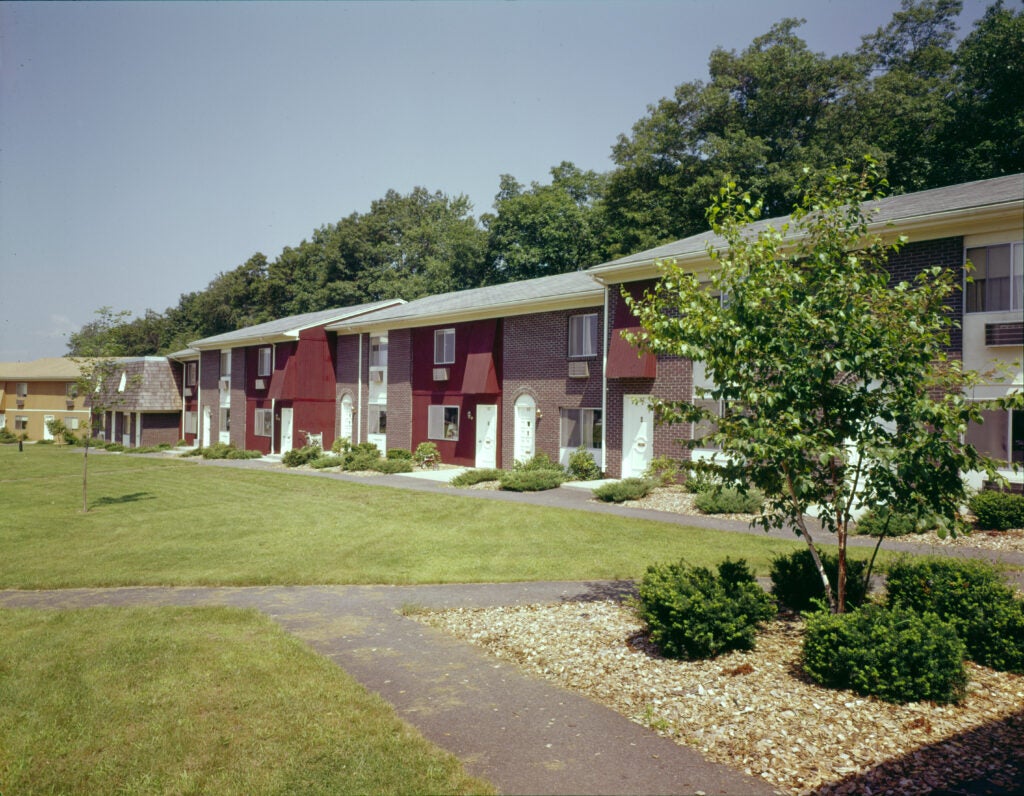
Rolling Green in Amherst was the first multifamily community financed by MassHousing
The data are in, and the results are definitive. Nearly 92,000 rental units produced or preserved. More than 95,000 first-mortgage loans approved. Approximately $62.5 million in grants and low-interest funding to make Massachusetts homes safer, healthier, more energy efficient, and accessible. Year-over-year and dollar-for-dollar across six decades, MassHousing has proved to be one of our nation’s most effective government initiatives at promoting economic growth and empowerment for individuals and communities in the Commonwealth.
As MassHousing celebrates the 60th anniversary of its founding, it is instructive to look back at how it all began. On the face of it, the Agency’s monumental success appears inevitable. Nationwide progress in the era from post-World War II through the mid-1960s is still considered by scholars to be a golden age of public housing. At the time of MassHousing’s creation in 1966, though, the paradigm for state-based operations was largely untested. Existing government housing policies and interventions were generated predominantly at the federal level.
Starting in the early ’60s, wide-ranging cultural upheaval and population shifts combined with chronic underinvestment in public housing repair and maintenance triggered a downward spiral of the national model. The appetite for federally driven and funded affordable housing initiatives in the U.S. Congress and across successive presidential administrations began to erode—a trend that continues to this day. Fortunately for Massachusetts residents, state lawmakers of the day recognized both the obligation and the opportunity to revolutionize the public sector’s role in supporting affordable housing.
Truly Enabling Legislation
For several months in 1965, a group of smart, experienced, and deeply committed state legislators—including the sitting and one future Massachusetts governor—convened the Special Commission on Low Income Housing. After dozens of hearings and extensive research, the commission issued recommendations that included the formation of a new a quasi-public entity to finance the production of mixed-income rental housing. The passage of Chapter 708 of the Acts of 1966 made it official—the Massachusetts Housing Finance Agency (MHFA) was born. It was the second such state-based housing initiative in the country.
Although the enabling legislation included a shoestring appropriation of $300,000 to launch its operations, the MHFA was to receive no further taxpayer funding to fulfill its mission. Instead, the Agency was authorized to sell tax-exempt and taxable bonds and use the proceeds to fund its projects—a constraint that over time turned out to be truly enabling rather than limiting. Because the MHFA did not have to make an annual sojourn to Beacon Hill for its operating capital, the Agency could be more nimble, creative, self-sustaining, and market-driven when devising solutions for affordable housing in Massachusetts.
Not everyone was thrilled with this new model for financing mixed-income rental housing. The Massachusetts Mortgage Bankers Association (MMBA) quickly launched legal challenges that delayed the MHFA’s actual launch by a full two years. Lenders argued that the Agency’s plans represented unfair competition that would disadvantage bankers’ businesses. In the end, the Massachusetts Supreme Judicial Court (SJC) ruled that the MHFA’s proposed activities were consistent with the intent of the enabling legislation, and the Agency set up shop at Old City Hall in Boston at the end of 1968.
Collaboration and Creativity in its DNA
The institutional DNA of the MHFA was apparent from its earliest days. Its first project was a 1969 rental housing development loan with legendary Massachusetts-based developer Sidney Rosenthal of Meredith Management. “My father proudly worked hand-in-hand with Agency leadership and staff to craft the MHFA’s first mixed-income development financing project for our 204-unit Rolling Green complex in Amherst,” says second-generation Meredith president John Rosenthal. “Ever since, the MHFA has matched our commitment to people and to housing communities traditionally overlooked by conventional lenders and developers. They’re a great financial partner and have always honored our relationship. They’ve stuck with us—and this challenging segment of the market—through good times and bad. The Agency has always remained true to the mission of providing safe, quality, affordable housing.”
Further evidence of the MHFA’s resilience and reliability came in the early 1980s when the Massachusetts Home Mortgage Finance Agency (MHMFA) was struggling with its debt cap. It needed a solid partner, and the two agencies merged to become what is now known as MassHousing. The expanded capabilities of the new entity launched a pattern of innovation and consumer responsiveness that has kept Massachusetts at the forefront of state-based affordable housing programs in the U.S.
“The staff and leadership at MassHousing have always been big thinkers,” says Stockton Williams, Executive Director of the National Council of State Housing Agencies in Washington, D.C. “Massachusetts is a challenging state—Boston is extremely expensive, and the state comprises markets ranging from old industrial urban landscapes to very rural communities. MassHousing embraces every type of challenge. Not only is it one of the oldest state housing finance agencies, it’s one of the most forward looking, creative, and successful in the country.”